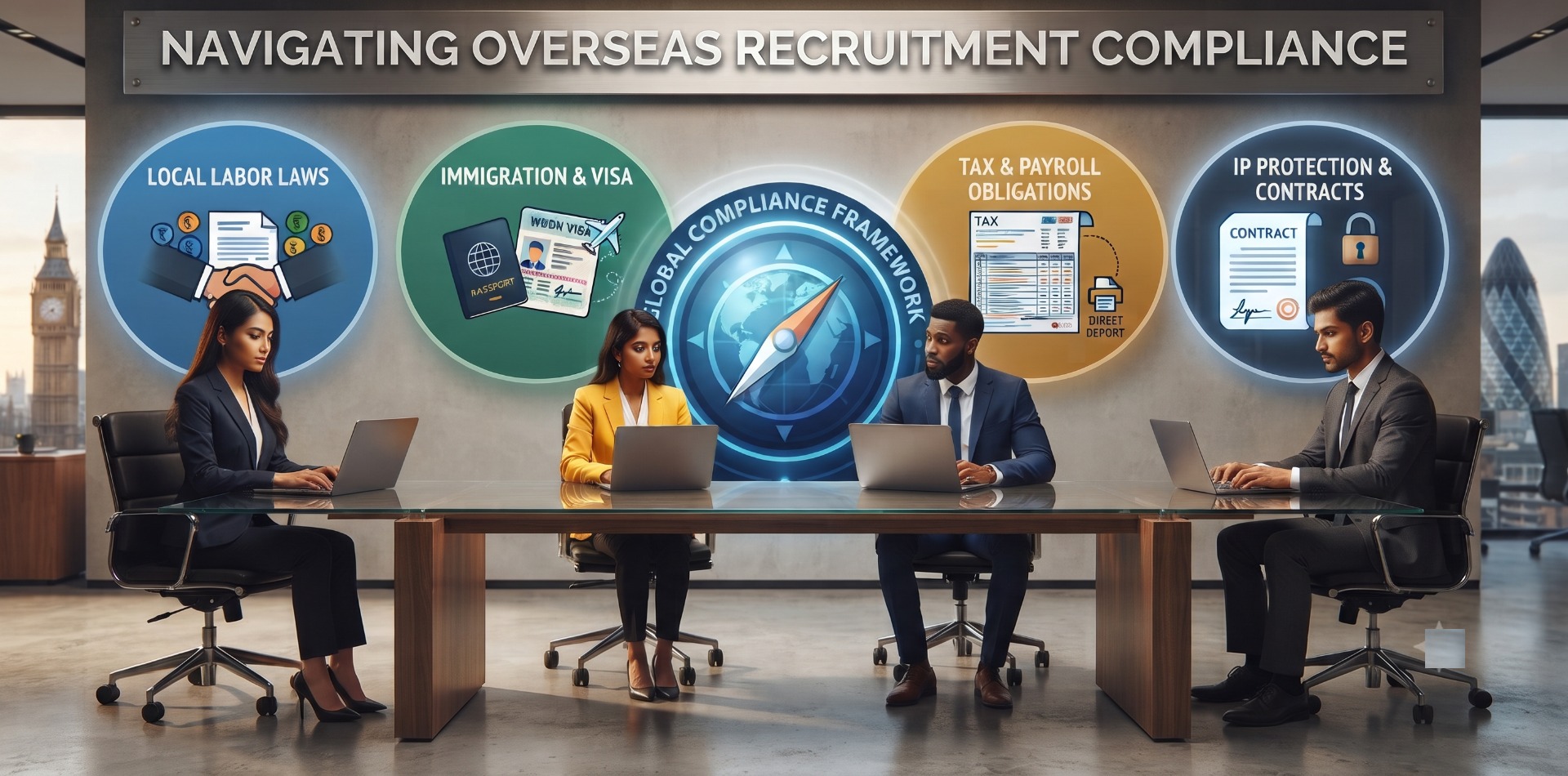
Businesses building teams are no longer limited by geography. Expansion, remote hubs, and foreign acquisitions all depend on cross-border hiring. Bringing international talent on board is more than sending an offer across an ocean.
Foreign employment law, tax, culture, and compliance can become a minefield. Two practices protect the organisation from legal liability, financial penalties, and operational friction: manpower audits and due diligence. They protect the employer and the employee.
1. Cross-border hiring and its hidden risks
Cross-border hiring usually takes one of two forms:
- Direct employment. Hiring remote workers, or setting up a local entity to employ people in another jurisdiction.
- M&A and restructuring. Acquiring a company overseas and absorbing its workforce.
Domestic HR practice does not travel intact. Termination rules in Western Europe are strict compared with at-will employment in parts of the United States. Mandatory benefits, worker classification, and data privacy rules such as GDPR carry real compliance risk. Without oversight, companies face:
- Legal penalties, including fines and, in some cases, criminal liability for breaches of local labour codes.
- Tax and social-security liabilities from unpaid payroll taxes, withholding errors, or miscalculated contributions.
- Operational disruption from disputes, union resistance, or wrongful-termination claims.
2. Due diligence in international expansion
When you acquire a foreign company or enter a new market, HR due diligence is the first line of defence. Financial and legal due diligence read the balance sheet and the contracts. HR due diligence reads the people, the policies, and the liabilities. It typically covers:
- Contracts. Legacy liabilities, guaranteed bonuses, severance, and whether non-competes can be enforced.
- Compensation and benefits. Local salary structures, healthcare, pensions, and statutory or contractual benefits, checked against local law and the market.
- Disputes. Employment tribunals, discrimination claims, and wage-and-hour issues that would transfer with the deal.
- Right to work. Valid visas, work permits, and legal authorisation for every foreign worker.
Finding these risks early lets leadership price them into the negotiation or plan the remedy before the deal closes.
3. What a manpower audit is, and why it matters
Due diligence is often tied to a transaction or a market entry. A manpower audit is an ongoing review of workforce structure, skills, deployment, and performance. Across borders, it shows whether global talent is deployed efficiently. A thorough audit looks at:
- Capacity and utilisation. Where the organisation is over-staffed, and where it is thin.
- Skills gaps. Whether international teams have the technical competence the market actually needs.
- Compliance alignment. Whether employment practice in each country still matches local rules and corporate governance.
- Cost. The total cost of employment — local taxes, benefits overhead, and exchange-rate movement — so budget follows the real cost of a hire.
4. How to put audits and due diligence to work
- Use local experts. Domestic counsel is not enough. Work with local employment lawyers, tax advisers, and HR consultants who know the region.
- Use technology and an employer of record where you have no entity. A trusted EOR can carry compliance, payroll, and local onboarding while you test a market.
- Keep global principles and local rules distinct. Culture and values can be shared. HR policy has to flex where local labour law is mandatory.
- Re-audit. Labour law, tax, and immigration change. A one-time review goes stale.
Cross-border hiring opens diverse talent, wider innovation, and faster scale. The labour landscape in each country still deserves respect. Manpower audits and due diligence turn that uncertainty into a plan, so the global workforce becomes a durable engine rather than a liability.